Live cohorts, hybrid delivery — Ameerpet, Hyderabad & online
Quality Thought logo Quality Thought AI FDE Program
Admissions open 20 weeks · Live Hyderabad & online

Become an AI Forward Deployed Engineer

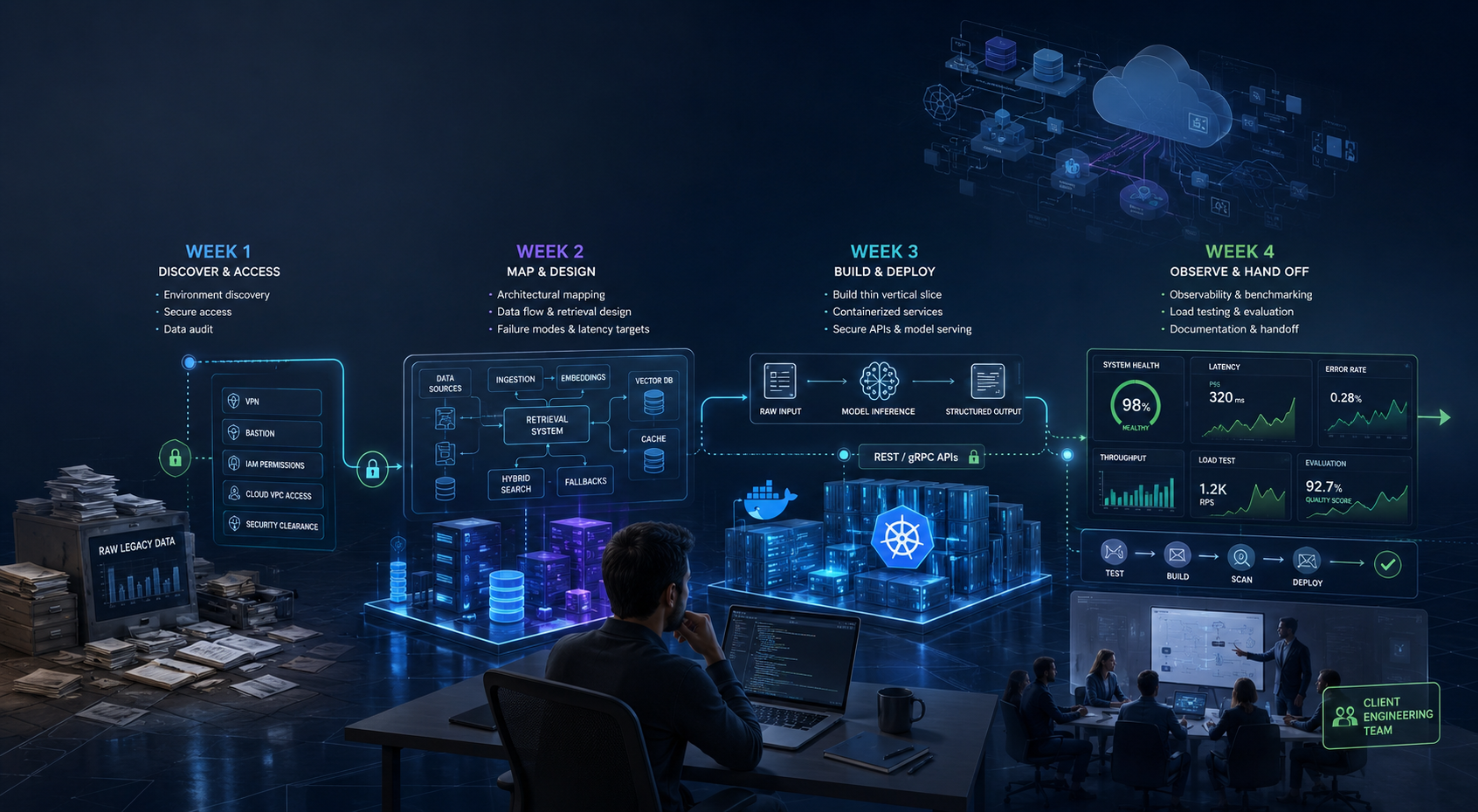
Most AI never leaves the demo. This program trains you for the role that gets it shipped — sitting with the customer, working inside their messy real systems, and owning the build until it’s genuinely in use.

  • Two tracks in one program: AI engineering depth and the customer-facing delivery craft most courses skip.
  • Build and deploy 6 real systems — RAG, agents, evaluation, integration — not notebooks.
  • Finish with a defended capstone and a portfolio you can walk an interviewer through.

No obligation. We’ll send the current fee structure, cohort dates and a full syllabus.

20 weeksLive, part-time
10 modulesAcross both tracks
6 buildsDeployed, not simulated
30 seatsPer cohort

Get the syllabus & fees

Tell us where to send it. An advisor follows up within one working day.

India

By submitting you agree to our privacy policy. We don’t share your details.

Live sessions, not recordings Hybrid — Ameerpet campus or online Every module ends in something deployed Portfolio & interview preparation included
Program overview

A single program for the two halves of the job

A Forward Deployed Engineer is the engineer a company sends to the customer. Half the work is building AI systems that hold up in production. The other half is everything around it — understanding a business you didn’t grow up in, scoping honestly, and getting a sceptical team to actually adopt what you built. We teach both, in the same twenty weeks.

Build the system

LLM applications, retrieval, agents, evaluation and guardrails — written as production code with tests, not prompts in a notebook.

Understand the customer

Discovery calls, workflow mapping and honest scoping, so what you build solves the problem the business actually has.

Deploy it inside their world

Cloud deployment, integration with systems you didn’t write, observability and cost control once real users arrive.

Make it stick

Adoption, enablement, documentation and clean handover. A system nobody uses has failed, however good the engineering.

Why FDE, why now

The bottleneck moved from models to deployment

Capability is no longer the constraint. Companies can reach a frontier model with an API key. What they cannot do is get that model to work against their own data, their own permissions model, their own half-documented internal systems — and get their own people to trust it.

That gap is why the Forward Deployed Engineer role has moved from a Palantir job title to something AI product companies, enterprise vendors and Indian GCCs are hiring for directly. It rewards a specific profile: someone who can write the code and sit in the room.

Last mile Where AI projects stall — integration, permissions, data quality and adoption, not model choice.
Hybrid skill Engineering depth plus customer-facing delivery. Rare enough that it commands a premium.
Hyderabad A dense concentration of GCCs and product engineering teams standing up AI delivery functions.
Durable Tools change every quarter. Scoping, evaluation and deployment discipline don’t.
Curriculum

10 modules across two parallel tracks

The engineering track and the delivery track run alongside each other, so you are practising the conversation and the code in the same week. Expand any module to see what it covers.

01

The FDE mindset and the discovery call

Delivery track Weeks 1–2

Why AI pilots stall, and the questions that surface the real constraint in the first hour with a customer.

  • What an FDE owns that an SWE, MLE or SA does not
  • Running a discovery call without pitching
  • Mapping a workflow to find where value actually leaks
  • Separating the stated problem from the real one
  • Writing a one-page problem statement the customer signs off
02

Production Python & Service Foundations

Engineering track Weeks 1–2

The engineering floor the rest of the program stands on. Written as services you could hand to a customer, not notebooks.

  • Typed Python, packaging and project layout
  • Async IO and concurrency that survives load
  • FastAPI services, validation and error contracts
  • Postgres and SQL you can reason about
  • Git workflow, testing and CI basics
03

LLM application engineering

Engineering track Weeks 3–5

Working with models as unreliable components: bounded, tested and observable rather than trusted.

  • Prompting as an engineering practice, not a craft secret
  • Structured output, schemas and validation
  • Function and tool calling
  • Context windows, chunking and cost control
  • Streaming, timeouts, retries and graceful degradation
04

Retrieval and RAG that holds up

Engineering track Weeks 6–8

Most RAG demos work and most RAG systems don't. This is the gap.

  • Ingestion pipelines over messy real documents
  • Embeddings, vector stores and hybrid search
  • Re-ranking, query rewriting and metadata filters
  • Evaluating retrieval separately from generation
  • Grounding, citations and refusing to answer
05

Agents, tools and multi-step systems

Engineering track Weeks 9–11

Agentic patterns applied where they earn their complexity — and recognising where they don't.

  • Single-agent loops, planning and reflection
  • Multi-agent orchestration and hand-offs
  • MCP and tool interfaces
  • Memory, state and long-running workflows
  • Human-in-the-loop checkpoints and approvals
06

Scoping, estimating and the technical proposal

Delivery track Weeks 9–11

Turning a discovery conversation into something a customer can approve and an engineer can build.

  • Sizing an AI build honestly, including the unknowns
  • Success criteria that can actually be measured
  • Writing the solution architecture for a mixed audience
  • Pricing conversations and scope boundaries
  • Saying no, and proposing the smaller thing that works
07

Evaluation, guardrails and reliability

Engineering track Weeks 12–14

The discipline that separates a demo from something a business will depend on.

  • Building eval sets from real customer data
  • LLM-as-judge, and when not to trust it
  • Regression testing prompts and pipelines
  • Prompt injection, data leakage and access control
  • Red-teaming your own system before the customer does
08

Deployment, integration and operations

Engineering track Weeks 15–17

Getting into the customer's environment — usually the hardest part of the job.

  • Docker, environments and configuration
  • Cloud deployment on AWS or Azure
  • Integrating with systems you did not build
  • Observability, tracing and cost dashboards
  • On-call realities, incidents and rollback
09

Adoption, enablement and handover

Delivery track Weeks 15–17

A system nobody uses has failed, however good the engineering was.

  • Driving adoption with a sceptical user group
  • Training, documentation and runbooks
  • Measuring usage and reporting outcomes
  • Managing change requests and scope creep
  • Clean handover to the customer's own team
10

Deployment capstone and demo day

Capstone Weeks 18–20

One end-to-end build against a real brief, delivered and defended the way an FDE delivers to a client.

  • Discovery through to deployed system
  • Evaluation report and known limitations
  • 90-day adoption plan
  • Live demo under questioning
  • Portfolio write-up and interview narrative
AI tools & technology stack

The stack you’ll actually deploy with

Tooling is taught as a means, not a syllabus. You learn the pattern first — retrieval, orchestration, evaluation — then the tools that currently implement it best, so the skill survives the next release cycle.

Models & inference

OpenAI GPT Anthropic Claude Google Gemini Llama / open weights Groq Low-latency inference

Agents & orchestration

LangChain LangGraph LlamaIndex MCP Model Context Protocol Pydantic AI

Retrieval & vector stores

pgvector Pinecone Qdrant Elasticsearch Hybrid search Neo4j Graph retrieval

Data & pipelines

PostgreSQL Redis Airflow dbt Kafka

Deployment & cloud

Docker Kubernetes AWS Azure GitHub Actions Terraform

Evaluation & observability

LangFuse OpenTelemetry Ragas RAG evaluation Grafana Guardrails

Interfaces & product

FastAPI Streamlit Next.js Figma
Hands-on projects

Every project starts with a business problem

Each build is framed the way an FDE receives work: a customer with a problem, not a dataset with a target column. You scope it, build it, evaluate it and deploy it.

foundation

Document intelligence over a messy archive

An operations team cannot find anything in fifteen years of scanned contracts.

Build the ingestion, retrieval and citation layer that turns an unsearchable archive into something a non-technical team can question in plain English.

FastAPI pgvector hybrid search re-ranking
foundation

Support ticket triage and routing

A SaaS company routes 4,000 tickets a month by hand and misroutes a third of them.

Classify, prioritise and route incoming tickets, with confidence thresholds that escalate to a human instead of guessing.

Structured output evals webhook integration
intermediate

Internal knowledge assistant with access control

HR wants a policy assistant, but half the source documents are restricted.

Retrieval that respects per-user permissions, so the assistant answers what the asker is allowed to know and nothing else.

Row-level security metadata filtering audit logging
intermediate

Sales research agent

An enterprise sales team spends six hours a week manually researching accounts.

A multi-step agent that gathers, verifies and summarises account intelligence, with sources attached and a hard stop on speculation.

Tool calling MCP planning loops caching
intermediate

Data quality and reconciliation copilot

Finance reconciles two systems that disagree, every single month-end.

An assistant that explains discrepancies in business language and proposes fixes for a human to approve.

SQL generation validation human-in-the-loop
capstone

End-to-end deployment capstone

A brief you scope yourself, from first call to deployed system.

Discovery, architecture, build, evaluation, deployment and a 90-day adoption plan — presented and defended on demo day.

Your choice justified in the architecture document
Learning methodology

Built the way delivery actually runs

No week is passive. The pattern repeats: understand the problem, build something that works, have it torn apart, then fix it. It is uncomfortable and it is the fastest way we know to make the job feel familiar before you're doing it for real.

Cohorts are capped so every submission gets read by a human, and every learner presents at least twice before the capstone.

  1. Live build sessions

    Two to three sessions a week, taught live with code on screen. Recorded, but designed to be attended.

  2. Weekly shipped increment

    Every week ends with something running. Reviewed against the same standards a customer would apply.

  3. Customer simulations

    Discovery calls and demos role-played with a mentor playing a difficult stakeholder. Recorded and critiqued.

  4. Code & architecture review

    Small-group review with a practising engineer. Where most of the real learning happens.

  5. Capstone & defence

    A full delivery you present and defend under questioning, exactly as you would to a client.

Career opportunities

Roles this program prepares you for

The same skill set opens several adjacent titles. Salary figures are market ranges compiled from public sources for 2026 — context for planning, not a promise from us.

Roles, indicative salary ranges in India and globally, and typical employers
Role What you’d own India (indicative) Global (indicative)
Forward Deployed Engineer Sits with the customer, owns the build inside their environment, and stays until it is genuinely in use. ₹18–45 LPA $140k–$280k
AI Solutions Engineer Pre-sales and delivery combined: proves the platform can solve the problem, then makes it true. ₹15–35 LPA $120k–$220k
AI Engineer / LLM Engineer Builds the application layer over models — retrieval, agents, evaluation and the serving path. ₹14–38 LPA $130k–$250k
AI Implementation Consultant Client-facing delivery lead for AI programmes, owning scope, adoption and outcomes. ₹16–40 LPA $120k–$210k
Applied AI / Platform Engineer Builds the internal platform other teams deploy AI on: gateways, evals, observability, cost control. ₹18–42 LPA $140k–$260k
Technical Account / Customer Engineer The long-term technical owner of an account, expanding the deployment after the first win. ₹12–30 LPA $110k–$190k

Ranges vary widely with prior experience, company and location. We share what we see in the market; we don’t guarantee a package, and we’d be wary of anyone who does.

Who should join

This is a good fit if you already write code

The program moves quickly and assumes you can build. What it adds is AI systems depth and the delivery craft around them.

  • Software engineers moving into AI product work
  • Data & ML engineers who want to own delivery, not just models
  • Consultants and solution architects adding hands-on AI depth
  • Final-year and recent CS graduates with genuinely solid fundamentals
Prerequisites

What we assume you bring

We assess these in the admission call rather than taking them on trust — it is fairer to everyone than discovering the gap in week three.

  • Comfortable programming in at least one language
  • Working knowledge of Python — you can build and debug a small application
  • Basic SQL and an understanding of relational data
  • Familiarity with APIs, HTTP and Git
  • Enough English to run a customer conversation
  • A laptop with 16 GB RAM. No GPU needed — we use hosted model APIs

Prior machine-learning theory is not required. The AI content is built from the ground up.

Duration, batches & mode

Pick the cohort that fits your week

Twenty weeks either way. Around 6 hours of live sessions plus 6–10 hours of build work per week — the capstone weeks are heavier.

Weekend Cohort

Enrolling
Duration
20 weeks
Mode
Hybrid — campus or online
Schedule
Sat & Sun, 10:00 AM – 1:00 PM IST
Seats
30 per cohort
Check eligibility & fees

Weekday Evening Cohort

Enrolling
Duration
20 weeks
Mode
Live online
Schedule
Mon, Wed & Fri, 8:00 – 10:00 PM IST
Seats
30 per cohort
Check eligibility & fees

Forward Deployed Engineer Workshop

Enrolling
Starts
19 Sep 2026
Duration
20 weeks
Mode
Live online
Schedule
Wed, 16th Sep 2026 | 7:30PM IST
Seats
7 of 10 left
Check eligibility & fees
Mentorship

Small cohorts, practising mentors

Every learner is assigned a mentor for the whole program — the same person across all twenty weeks, so the feedback compounds instead of resetting.

  • Weekly small-group code and architecture review
  • One-to-one checkpoints at weeks 5, 11 and 17
  • Mock discovery calls and demos with real critique
  • Cohort channel that stays open after you finish
Certification

Certified on what you built

On completion you receive the Quality Thought AI Forward Deployed Engineer certificate. It is awarded on the capstone, not an exam — you certify by delivering and defending a working system.

Program certificate

Issued by Quality Thought on successful capstone defence, with a verifiable reference.

Documented portfolio

Your deployed builds, written up with architecture decisions and known limitations — what actually moves an FDE interview.

Placement & career support

What we do, and what we don’t promise

We will put real work into getting you interview-ready and in front of people. We won’t promise you a job or a number — no training institute controls either, and pretending otherwise is how learners get misled.

Portfolio positioning

Your projects written up as case studies — problem, decisions, trade-offs, outcome — and a résumé rebuilt around them.

Interview preparation

Mock rounds for the full FDE loop: system design, AI depth, customer scenario and behavioural.

Hiring introductions

Referrals through the Quality Thought hiring network across Hyderabad, Bengaluru and remote-first employers.

Alumni network

Continued access to the cohort channel and alumni community after you finish.

Profile review

LinkedIn and GitHub reviewed by someone who has hired for these roles, not a template.

Refresher access

Re-attend any module in a later cohort at no cost within twelve months.

Instructors & mentors

Taught by people who do the job

Every session is led by someone currently building and deploying AI systems — not a full-time trainer working from slides.

Lalith Roy

Lalith Roy

Forward Deployed Engineer · TCS

Lalith Roy is a seasoned technology professional and Forward Deployed Engineer at CTS, bringing 18 years of experience across engineering, technology consulting, and customer-focused solution delivery. Over the course of his career, he has worked with leading organizations, including Google and Wipro, gaining extensive exposure to complex technology environments and enterprise-scale solutions. Lalith specializes in translating business challenges into practical, scalable, and high-impact technical solutions. His experience spans engineering, problem-solving, stakeholder collaboration, and delivering technology-driven outcomes. Passionate about innovation and continuous learning, Lalith combines deep technical expertise with a customer-centric approach, helping organizations leverage technology effectively to solve real-world challenges and accelerate growth.

AI & Machine Learning RAG System Design & Integration Cloud Computing & Solutions
Questions

Frequently asked questions

Straight answers. If yours isn’t here, call or message us — we’d rather talk than guess.

What is a Forward Deployed Engineer?
A Forward Deployed Engineer builds and deploys software inside the customer's own environment. Instead of shipping a product and moving on, an FDE works alongside the client team — learning their domain, integrating with their systems, and staying until the solution is actually in use. In AI, the role exists because most models fail at the last mile: the technology works in a demo but never survives contact with real data, real permissions and real users.
How is the AI FDE Program different from a normal AI or data science course?
A data science course teaches you to build a model. This program teaches you to deliver a working system to a customer. Roughly two-thirds is engineering — LLM applications, retrieval, agents, evaluation, deployment — and one-third is the delivery craft that AI courses skip: discovery calls, scoping, adoption and handover. You leave with deployed systems and a portfolio, not notebooks.
Who should join the AI Forward Deployed Engineer Program?
Software engineers moving into AI product work, data and ML engineers who want to own delivery rather than just models, consultants and solution architects adding hands-on AI depth, and strong final-year or recent computer science graduates with solid programming fundamentals.
What are the prerequisites?
Comfortable programming in at least one language, working knowledge of Python, basic SQL, and familiarity with APIs and version control. Prior machine learning experience is helpful but not required — the AI content is built from the ground up. What we cannot teach quickly is the ability to write and debug real code, so that is the bar.
Can freshers join the program?
Yes, if the programming fundamentals are genuinely there. The role is customer-facing and demanding, so we assess this in the admission call rather than assuming it. Final-year students and recent graduates who can already build and debug a small application do well.
How long is the program and what is the time commitment?
Twenty weeks, delivered live. Expect around 6 hours of live sessions and 6 to 10 hours of independent build work each week. The capstone in the final weeks is heavier. Sessions are recorded, so a missed class is recoverable — but the build work is not optional.
Is the program online or classroom based in Hyderabad?
Both. Live online sessions run for every cohort, and learners in Hyderabad can attend in person at our Ameerpet campus, including lab and mentoring sessions. The capstone demo day is run as a hybrid event.
What happens if I miss a live session?
Every session is recorded and available to your cohort. Mentors hold weekly doubt-clearing slots, so you can catch up on the concept and still submit that week's build.
What roles can I apply for after completing the program?
Forward Deployed Engineer, AI Solutions Engineer, AI or LLM Engineer, AI Implementation Consultant, Applied AI Engineer and Technical Account Engineer. These roles sit across AI product companies, enterprise platform vendors, consultancies and the global capability centres hiring in Hyderabad and Bengaluru.
Do you provide placement support?
We provide career support: portfolio review, a positioning and résumé rewrite around your deployed projects, mock technical and customer-facing interviews, and introductions through the Quality Thought hiring network. We do not promise a job or a specific salary — any institute that does is selling you something it cannot control.
What salary can an AI Forward Deployed Engineer expect in India?
Market ranges as of 2026 sit roughly between ₹18 and ₹45 LPA for an FDE role in India, with senior and lead positions going higher. Compensation depends heavily on your prior experience, the company and the location, so treat these as market context rather than a promise.
What is the fee, and are instalments available?
Fees vary by cohort and are shared on the admission call along with the current instalment options and any early-enrolment concession. Submit the enquiry form and an advisor will send the current fee structure.
Will I get a certificate?
Yes. On completion you receive a Quality Thought AI Forward Deployed Engineer certificate, awarded on the capstone rather than an exam — you certify by delivering and defending a working system. You also leave with a documented portfolio of deployed projects, which matters far more in an FDE interview.
Which AI tools and technologies will I learn?
Python and FastAPI, the major model APIs including OpenAI, Anthropic Claude and Google Gemini, LangChain and LangGraph, MCP, vector stores such as pgvector, Pinecone and Qdrant, evaluation tooling including Ragas and LangFuse, and deployment on Docker, AWS or Azure with GitHub Actions. The emphasis is on patterns that outlive any one tool.
Do I need my own laptop or GPU?
A laptop with 16 GB of RAM is enough. The program uses hosted model APIs rather than local training, so no GPU is required. Cloud credits for the deployment modules are covered within the program.
Talk to us

Tell us where you are, and we’ll tell you honestly whether this fits

A twenty-minute call with an advisor. You’ll get the full syllabus, the current fee structure and cohort dates — and a straight answer on whether your background is ready for this program or would be better served by something else first.

Request a callback

Fields marked * are required. Everything else just helps us prepare.

India
India

We’ll only use this to contact you about the program. See our privacy policy.

The engineers who can ship AI are the ones who get to build it

Twenty weeks, a capped cohort and a portfolio of systems you actually deployed. Start with a conversation — we’ll tell you straight whether it’s the right move.